
.png)
Italy 🌍
Rome ✈️
Uri Travel ✈️| Italy 🇮🇹 | Rome Attractions Map | Rome Itinerary | Vatican City | Colosseum | Rome with Kids
Welcome to the most up-to-date guide for Rome 2026.
Rome considered the "Eternal City" is a rare combination of rich historical heritage, tourist attractions and so much fooooood. In this guide I have gathered the Rome attractions that are a must see up close from the Colosseum and the Roman Forum to the Trevi Fountain, the Pantheon, and the Spanish Steps, all the way to Vatican City and St. Peter's Basilica.

Watch the Video🍿
The 10 Must-See Attractions in Rome
✈️
✈️Asia
🇮🇳 India | Hyderabad
🇮🇳 India | Mumbai
🇮🇳 India | Pune
🇮🇱 Israel | North
🇮🇱 Israel | South
🇸🇬 Singapore
🇦🇪 UAE | Dubai
🇹🇭 Thailand
✈️Europe
🇦🇱 Albania
🇧🇬 Bulgaria | Varna
🇨🇾 Cyprus | Paphos
🇨🇿 Czech Republic | Prague
🇩🇰 Denmark
🇬🇧 England | London
🇫🇷 France | Paris
🇬🇪 Georgia | Batumi
🇩🇪 Germany | Munich
🇬🇷 Greece | Athens
🇬🇷 Greece | Northern Greece
🇭🇺 Hungary | Budapest
🇮🇹 Italy | Rome
🇲🇪 Montenegro
🇳🇱 Netherlands | Amsterdam
🇵🇱 Poland | Warsaw
🇷🇴 Romania
🇷🇸 Serbia | Belgrade
🇪🇸 Spain | Barcelona
🇪🇸 Spain | Madrid
🇻🇦 Vatican
✈️America
🇨🇦 Canada | Niagara Falls
🇨🇦 Canada | Toronto
🇲🇽 Mexico | Mexico City
🇺🇸 United States | Boston
🇺🇸 United States | Las Vegas
🇺🇸 United States | Los Angeles
🇺🇸 United States | New York
✈️
Rome is one of the most beautiful cities in the world, filled with countless incredible attractions. It’s a city that never stops surprising you, with its lively parties, vibrant festivals, rich history, and stunning architecture. From iconic landmarks like the Colosseum and the Roman Forum to the charm of its hidden streets and piazzas, there's always something to explore. For me, Rome is the happiest city I've visited, offering a perfect blend of culture, excitement, and warmth. I can't wait to return and experience it all over again.
I want to start this blog with a few key highlights:
-
😁 This blog covers several visits to Rome that I have combined into one comprehensive travel guide. All these trips shared one common theme; Rome is truly one of the happiest places I have ever visited!
-
💦Throughout Rome, you will find dozens of fountains offering cold, clean water, perfect for refilling your bottle. If you don't have a bottle and are feeling thirsty, here is a pro tip to avoid bending over: if you plug the main opening of the tap with your finger, the water will shoot out of a small hole on top, creating a drinking fountain that is much easier to use 💪
-
🩰👠 Ladies, this one is for you, the sidewalks in Rome are not comfortable for walking by any means. Do not bring high heels. If you are traveling with babies, I highly recommend using a baby carrier rather than a stroller, you will definitely thank me later.
-
🚕🚇 Getting around Rome is very simple. Most of the main attractions are close to one another, making the city very walkable. The public transportation system, especially the Metro, is well-developed. Another option that I found very helpful is the Uber app, which is quick and convenient.
-
🚗🚦🏴☠️A quick word about the drivers in Rome. be careful, be careful, and be careful again, especially with children. Right-of-way is rarely observed, and cars often don't stop at crosswalks, so please stay alert and watch where you are going.

Frequently Asked Questions
- 01
- 02
- 03
- 04
- 05
- 06
- 07
- 08
- 09
- 10
To ensure you don’t get lost in lines or transportation, I have organized the attractions from the guide into a smart 4-day itinerary, divided by areas. The numbers next to each attraction correspond to the attached map and the attraction reviews below.
-
Day 1: Ancient Rome at its Best - We will start in the historic heart of the city, where it all began.
-
Morning: A tour of the Colosseum (11) and the Roman Forum (10). It is highly recommended to arrive very early to avoid the long lines at the entrance to the world's most famous amphitheater.
-
Afternoon: A short walk toward the viewpoint from the Vittorio Emanuele II Monument (09).
-
Evening: Your first dinner in one of the restaurants in the alleys surrounding the area to soak up the atmosphere of the "Eternal City."
-
-
Day 2: Fountains, Squares, and Wishes - A Day dedicated entirely to walking between the attractions of the city center.
-
Morning: A visit to the Pantheon (7), the best-preserved Roman structure in the world. Don’t forget to look up at the "eye" in the ceiling and take a walk through Piazza Navona (8).
-
Afternoon: A walk to the Trevi Fountain (4). This is the time to toss a coin into the water (with your right hand over your left shoulder) to ensure you return to Rome.
-
Evening: Continue to the Spanish Steps (3) and the nearby Piazza di Spagna, a perfect area for photos.
-
-
Day 3: A Country Within a City: The Vatican - A Day entirely dedicated to the religious and artistic side of Rome.
-
Morning: Entry to Vatican City and St. Peter's Basilica (16). It is recommended to book tickets in advance for the Vatican Museums and the Sistine Chapel.
-
Afternoon: Climbing to the Dome of the Basilica for a panoramic view of all of Rome (an experience not to be missed).
-
Evening: Crossing the Tiber River back toward the city center and a high quality dinner in the Piazza area.
-
-
Day 4: Heading North toward Villa Borghese and the Surrounding Area.
-
Morning: A boat ride in Villa Borghese (1) and a walk through the park.
-
Afternoon: A visit to Piazza del Popolo (2), one of the most central and impressive squares in Rome.
-
Evening: A walk to Rome's main shopping street, Via del Corso (5).
-
Tip from Uri Travel 💛
At each point in the itinerary, you can find a full description, videos I filmed, and practical tips on arrivals and prices in the guide below.
Enjoy!
1. Villa Borghese
Villa Borghese serves as the heart and soul of Rome's green spaces and is often referred to as the city's green lung. Spanning eighty hectares, this heart-shaped park is where art, nature, and Roman life intersect perfectly, providing a peaceful escape from the bustling city streets.
The crown jewel of the park is undoubtedly the Borghese Gallery, which houses one of the world's most prestigious private art collections. Inside, you will find breathtaking masterpieces by Bernini, such as the famous Apollo and Daphne, alongside works by Caravaggio and Raphael.
At the center of the park lies the Laghetto di Villa Borghese, a small and picturesque artificial lake. You can rent a rowboat to glide past the Temple of Aesculapius, an eighteenth-century structure sitting on a tiny island. This is easily one of the most romantic spots in the city and offers a wonderful way to relax and cool off during a warm Roman afternoon.
For those visiting with families, the park offers plenty of activities beyond art. The Bioparco di Roma, one of Europe’s oldest zoos, is located within the grounds. To explore the vast area without tiring your feet, you can rent bicycles or four-person family bikes at various points near the park entrances. This is a particularly good idea given how uneven the Roman sidewalks can be elsewhere.
To end your visit, you should walk to the western edge of the park to find the Pincio Terrace. This spot offers an iconic panoramic view of Piazza del Popolo and the many domes of the city skyline. It is a beloved local tradition to gather here at sunset to watch the sky turn pink and gold over the Eternal City.
Website: Villa Borghese | sovraintendenzaroma
Watch the Video🍿
2. Piazza del Popolo
Piazza del Popolo located at the northern gate of the historic center and has long served as a ceremonial entrance to the city for travelers arriving from the north.
The square is dominated by a tall ancient Egyptian obelisk at its center, originally brought to Rome during the Roman Empire.
On one side of the square stand the twin churches Santa Maria dei Miracoli and Santa Maria in Montesanto, creating a striking and symmetrical view.
From Piazza del Popolo, three important streets fan out, including Via del Corso, which leads directly into the heart of Rome and is one of the city’s main shopping streets.
Nearby, the Pincian Hill offers a beautiful terrace with panoramic views over the square and the rooftops of Rome, especially stunning at sunset.
Today, Piazza del Popolo is a lively gathering place for visitors and locals, ideal for walking, relaxing, and enjoying the atmosphere of the city while being close to many major attractions.

3. Spanish Steps
The Spanish Steps (Scalinata di Trinità dei Monti) offering both a striking architectural feature and a popular gathering spot for locals and tourists alike. Located in the heart of the city, these steps connect the Piazza di Spagna (Spanish Square) at the bottom with the Church of Trinità dei Monti at the top. Here's more about them:
The Spanish Steps were built between 1723 and 1725 with the aim of linking the Piazza di Spagna to the Trinità dei Monti church at the top of the hill. The steps were commissioned by the French diplomat Étienne Gueffier and designed by the architects Francesco de Sanctis and Alessandro Specchi. They were named after the Spanish Embassy to the Holy See, located nearby, not because they originated in Spain.
The steps consist of 135 steps arranged in a graceful, flowing shape, with a slight curve that makes them one of the most photographed stairways in the world. The design is considered a masterpiece of Baroque architecture.
At the foot of the steps is a beautiful fountain, the Fontana della Barcaccia (Fountain of the Ugly Boat), designed by Pietro Bernini (father of Gian Lorenzo Bernini). The fountain resembles a sinking boat, reflecting the area’s history of flooding.
Watch the Video🍿
We visited Rome during the Christmas season, where we saw the Christmas parade setting off from the Spanish Steps, as shown in the video.
Watch the Video🍿
4. Fontana di Trevi
The Trevi Fountain (Fontana di Trevi) is an exquisite Baroque masterpiece designed by architect Nicola Salvi and completed by Giuseppe Pannini in 1762. It stands 26.3 meters (86 feet) high and 49.15 meters (161.3 feet) wide, making it the largest Baroque fountain in the city.
The fountain's focal point is a grand statue of Oceanus, the god of the sea, riding a chariot pulled by two sea horses. One horse is calm, while the other is more restless, symbolizing the sea's contrasting moods. The surrounding sculptures represent various figures from Roman mythology and water, including Abundance and Health.
Traditionally, visitors throw coins into the fountain over their left shoulder to ensure a return to Rome. It’s said that throwing one coin will guarantee your return, two coins will bring love, and three coins will lead to marriage. The fountain is also featured in several films, most famously in La Dolce Vita (1960), where Anita Ekberg wades through the fountain’s waters.
Watch the Video🍿
5. Via del Corso
Via del Corso is one of the main and most famous streets in Rome, running straight through the historic center of the city.
It connects Piazza del Popolo in the north with Piazza Venezia in the south and has been an important route since ancient Roman times.
Today, Via del Corso is known as a lively shopping street with a mix of international brands, Italian fashion stores, cafes, and small restaurants.
It is always busy with locals and visitors and is a popular place for strolling, shopping, and feeling the energy of the city.
The street is also surrounded by historic buildings, churches, and side streets that lead to major attractions such as the Trevi Fountain, the Spanish Steps, and Piazza di Spagna.
During holidays and special events, Via del Corso is beautifully decorated and becomes even more vibrant, making it a central part of the Roman experience.

6. Chiesa di Sant’Ignazio di Loyola
Chiesa di Sant’Ignazio di Loyola is one of the most impressive Baroque churches in Rome, famous for its remarkable artistic illusion.
The church was built in the 17th century and is dedicated to Saint Ignatius of Loyola, the founder of the Jesuit order.
Its most famous feature is the painted ceiling by Andrea Pozzo, which creates a stunning optical illusion of a soaring dome and open sky, even though no real dome exists.
When viewed from the marked spot on the floor, the perspective appears perfectly three dimensional and breathtaking.
Inside, the church is richly decorated with frescoes, marble, and gold details, reflecting the power and influence of the Jesuits at the time.
Located near the Pantheon, the church is free to enter and is considered a must see for art lovers and anyone interested in Baroque architecture and visual illusions.

7. Pantheon
The Pantheon in Rome was originally built as a temple to all the gods of ancient Rome. It is now a functioning church known as the Basilica of St. Mary and the Martyrs. The Pantheon's exceptional design and architectural innovations have inspired architects and artists for centuries.
The original Pantheon was commissioned by Marcus Agrippa in 27 BCE and later rebuilt by the emperor Hadrian around 118-125 CE after the original structure was damaged by fire. The inscription on the front of the Pantheon still credits Agrippa for its construction, though Hadrian's renovation was the final version that stands today.
It has been in continuous use throughout history, first as a pagan temple and since the 7th century as a Christian church.
The Dome: The Pantheon’s most famous feature is its massive, unreinforced concrete dome, which remains the largest of its kind in the world. The dome has a central oculus (opening) that allows light to flood the interior, creating a striking effect as sunlight moves across the floor throughout the day.
The Portico: The entrance features a grand portico with 16 massive Corinthian columns made of Egyptian granite. This is one of the building's most impressive features.
The Rotunda: Inside, the Pantheon’s circular shape and its unbroken dome create a sense of harmony. The interior is designed to symbolize the vault of the heavens.
Site: Pantheon Rome | Basilica of Santa Maria ad Martyres (pantheonroma.com)
.png)
8. Piazza Navona
Rome is filled with piazzas, but this is without a doubt the most magnificent and largest square in the city.
It is a Baroque masterpiece with an elliptical shape and serves as a major tourist attraction.
The piazza features three fountains, the most famous being the Fountain of the Four Rivers, representing the Danube, Río de la Plata, the Nile, and the Ganges.
The square was originally built in the 15th century, but its current design was redesigned in the 17th century by the architect Gian Lorenzo Bernini, under the direction of Pope Innocent X.
Bernini designed the square as a place for leisure and culture, with beautiful fountains, impressive sculptures, and stunning architecture.
During the Christmas season, a Christmas market takes place here, as shown in the video.
Watch the Video🍿
9. Altar of the Fatherland
The Monumento Nazionale a Vittorio Emanuele II, also known as the Vittoriano or Altar of the Fatherland, is one of Rome’s most iconic landmarks.
It was built in honor of Vittorio Emanuele II, the first king of unified Italy, and symbolizes the unification and national identity of the country.
Located in Piazza Venezia, the monument is made of white marble and stands out with its massive scale, grand staircases, columns, and statues.
At its center is the Tomb of the Unknown Soldier, guarded by an eternal flame, which commemorates Italian soldiers who died in war.
Visitors can explore terraces, museums, and panoramic viewpoints, including a glass elevator that offers spectacular views over Rome.
Although its monumental style contrasts with the ancient surroundings, the Vittoriano remains a powerful symbol of modern Italy and an important historical and cultural site.
Watch the Video🍿
10. Roman Forum
The Roman Forum (Forum Romanum) was the heart of ancient Rome and the Roman Empire, serving as the center for political, religious, and social life. Located between the Capitoline and Palatine hills, the Forum was known as the "Great Forum" (Forum Magnum). It hosted public assemblies, courts, gladiator battles, markets, and shops. It was also the site of significant religious ceremonies and monuments. At its center ran the Via Sacra ("Sacred Way"), where victory processions and religious rituals took place, marking it as a focal point of Roman power and culture.

11. Colosseum
The Colosseum (Latin: Colosseum, Italian: Colosseo) is the largest amphitheater ever built and a marvel of Roman engineering. Located in central Rome, it was commissioned by Emperor Vespasian in 70 AD and completed by his son Titus in 80 AD. It hosted gladiator games, mock naval battles, executions, and more, with a capacity of 40,000 to 70,000 spectators.
After its use as an entertainment venue, the Colosseum served various purposes over the centuries, including housing, workshops, and a fortress. Though damaged by earthquakes and looting, it remains an iconic symbol of Rome and the Roman Empire.
In 1980, it became a UNESCO World Heritage Site, and in 2007, it was named one of the Seven New Wonders of the World. After extensive renovations, the hypogeum (underground passages) opened to visitors in 2021, revealing the space where gladiators and animals were kept before battles.
It is one of Rome’s top tourist destinations, so it’s recommended to arrive early to avoid long lines.
Watch the Video🍿
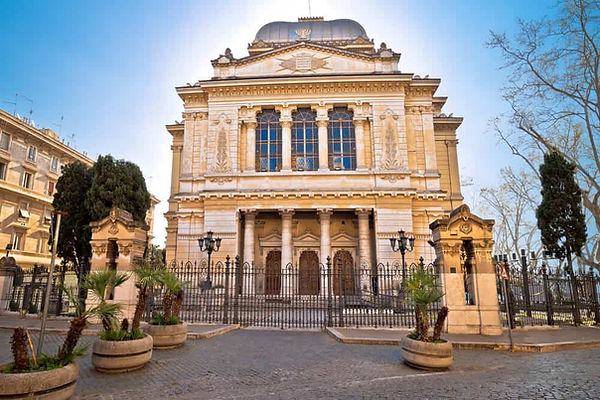
12. The Great Synagogue of Rome
The Great Synagogue of Rome, also known as the Tempio Maggiore, is the main synagogue of the Jewish community in Rome and one of the most important Jewish landmarks in Europe.
It is located near the Tiber River in the former Jewish Ghetto and was inaugurated in 1904 after Jews were granted full civil rights in Italy.
The synagogue is known for its distinctive square dome, which stands out in Rome’s skyline and is unique among the city’s religious buildings.
Its architectural style combines Art Nouveau with Assyrian Babylonian influences, making it visually different from both churches and older synagogues.
Inside, the synagogue is richly decorated with marble, mosaics, and stained-glass windows.
It remains an active place of worship and also houses the Jewish Museum of Rome, which tells the long and complex history of Jews in the city.
The Great Synagogue is a symbol of resilience, continuity, and the deep historical roots of the Jewish community in Rome, one of the oldest Jewish communities in the world.
Website: Home - Comunità Ebraica di Roma
13. Ponte dei Quattro Capi
Ponte dei Quattro Capi (also officially known as Pons Fabricius) is the oldest Roman bridge in Rome that still exists in its original form.
It was built in 62 BC and today connects Tiber Island with the eastern bank of the Tiber River near the old Jewish Ghetto area.
The name Quattro Capi (“Four Heads Bridge”) comes from the four-faced marble herms (two two-faced Janus figures) on the bridge’s parapet, which were added in the 14th century and gave the bridge its popular name.
The bridge was commissioned by Lucius Fabricius, a Roman official in charge of roads, and it replaced an earlier wooden crossing destroyed by fire. It has two stone arches supported by a central pillar and has been in continuous use from ancient times to today.
In medieval times it was sometimes called Pons Iudaeorum (“Bridge of the Jews”) because of its proximity to the Jewish quarter.
Website: Ponte Fabricio | Turismo Roma

14. Giardino degli Aranci
The Giardino degli Aranci, also known as the Orange Garden or Parco Savello, is a famous public park in Rome located on the Aventine Hill.
It is renowned for its beautiful orange trees, peaceful atmosphere, and some of the most stunning panoramic views of the city, including St. Peter’s Basilica and the Tiber River.
The garden was designed in the 1930s on the site of a former monastery and is named after the fragrant bitter orange trees planted there.
Visitors often come to stroll along its paths, enjoy the quiet surroundings, and take in the panoramic terrace at the edge of the garden, which is perfect for photos.
Website: Parco Savello o Giardino degli Aranci | Turismo Roma
Watch the Video🍿
15. Keyhole on Aventine hill
The keyhole in Rome is famous for its unique viewpoint. It is a large keyhole in the entrance gate of the Knights of Malta property, located on the Aventine Hill in southwestern Rome.
Through this keyhole, you can see a perfect view of the dome of St. Peter’s Basilica, perfectly centered in the frame through the trees and the square in front of the gate.
This keyhole has become especially popular among tourists and photographers. It creates a kind of natural optical illusion, making the dome appear perfectly framed by the surrounding vegetation and the gate.
Around the keyhole, there are well-kept gardens, peaceful paths, and small open spaces that add to the unique atmosphere of the place.

16. Vatican City
Vatican City is the smallest country in the world, located in the heart of Rome, serves as the spiritual and administrative center of the Catholic Church. It covers only 0.44 km², with about 800 residents, and has been independent since 1929 under the Pope’s leadership.
St. Peter’s Basilica the largest church in Christianity, built over the tomb of Saint Peter. Its iconic dome by Michelangelo dominates Rome’s skyline, while Bernini’s grand square welcomes pilgrims from around the world. Inside, visitors can admire masterpieces like Michelangelo’s Pietà and Bernini’s Baldachin.
The Sistine Chapel, world-famous for Michelangelo’s ceiling and The Last Judgment, as well as Renaissance frescoes by Botticelli and others. It is also the site of the Papal Conclave, where new popes are elected.
The Vatican remains a unique blend of religion, history, and art, attracting millions of visitors every year.
Website: Vatican Museums – Official Website
Watch the Video🍿
Additional Attractions
Cooking Class in Rome
We wanted to plan a special activity for children in Rome and decided on a hands-on cooking workshop.
In the workshop, the kids made real Italian pizza and classic tiramisu. They kneaded the dough, added toppings, and learned how to make pizza just like in Italy.
We started the workshop by preparing the tiramisu so it would have time to chill in the fridge and then moved on to making the pizza.
We enjoyed eating everything we made ourselves. It was a fun and bonding experience, full of delicious food, creating a perfect memory from our trip to Rome, as shown in the video.
Watch the Video🍿
Duck Store
Have you ever seen a store dedicated entirely to ducks? 🦆🦆🦆
Dream Duck in Rome is a unique and fun shop completely devoted to rubber ducks. It’s not a regular toy store, but a colorful place with hundreds of ducks in crazy designs, ducks dressed as famous characters, sports professions, holiday themes, and some that are just totally funny.
The shop attracts both children and adults in the Via del Corso area. Many people buy a duck as a unique souvenir from Rome or as a slightly unusual gift.
I asked the shop assistant what the idea behind the store was, and she said there are duck collectors around the world who trade them to complete their collections 🦆🦆🦆
Watch the Video🍿
======================
Hoping that you found the blog useful and helpful!
I'm already writing the next blog 😉
======================
======================
May the blog power be with you! ✈️